Stefan Stefanov

You just got your racquet restrung. First few hits feel incredible. A week later, shots are flying long, your arm aches, and you can't figure out what changed. Chances are, the tension was wrong for your game from the start.
String tension quietly shapes everything about how your racquet performs. Too tight, and you lose power and comfort. Too loose, and control disappears. According to the International Tennis Federation (ITF), most racquets have a recommended range printed on the frame, typically between 45 and 65 pounds. Even a shift of two or three pounds can change how your racquet feels.
Below is a step-by-step tennis racquet tension guide covering what tension actually does and how to choose a setup that matches your game.
Quick answer
Start at the midpoint of your frame's printed range, then adjust by 2 to 3 lbs based on feel. Beginners generally do well around 48 to 54 lbs, intermediate players around 52 to 57 lbs, and advanced players around 55 to 62 lbs.
How String Tension Affects Your Game

Every tension choice involves a trade-off. Knowing what you gain and give up at each end of the range makes the decision much easier.
Power vs. Control
Picture a trampoline. A loose one launches you high with little effort. A tight one gives a small, controlled bounce. Your racquet's string bed works the same way.
Lower tension (roughly 45 to 54 lbs): The ball tends to sink deeper into the string bed and rebound with more speed. Most players notice easier power and depth without swinging harder.
Higher tension (roughly 55 to 65 lbs): The string bed stays firmer, so the ball tends to leave the racquet more quickly. Most players experience sharper control and more predictable placement.
Spin
Power and control are only part of the picture. Looser strings also tend to move more on contact, allowing the ball to pocket deeper and the strings to snap back. That snap-back motion can help generate topspin, which is why many modern players actually prefer slightly lower tensions.
Comfort and Arm Health
Spin aside, tennis racket string tension also plays a role in how your arm feels after a long session. The ITF Injury Clinic notes that lower tension increases dwell time, spreading the shock of impact over a longer period. Players who experience elbow soreness or wrist fatigue often benefit from dropping a few pounds. Higher tension can transmit more impact force to the arm, which may contribute to discomfort over time.
Wondering if your current tension is actually working? Spintip's PULSE gives you a performance number for every single point you play. Change your tension, play a session, and see whether your score trends up or down. No guessing required.
Step 1: Know Your String Material
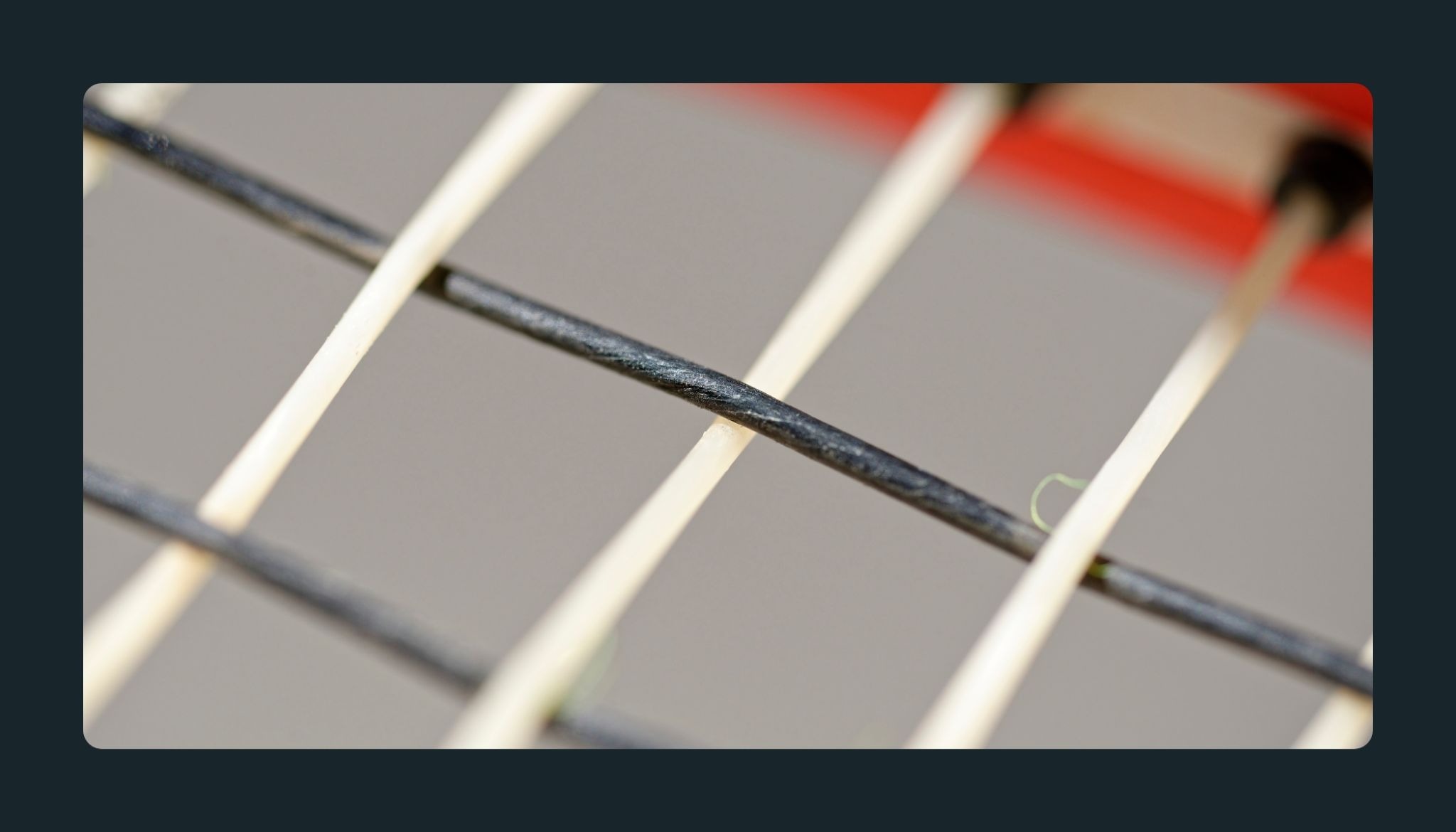
The type of string on your racquet directly influences which tension range makes sense.
Nylon and natural gut: Elastic and comfortable. A good starting range sits around 50 to 60 lbs. Natural gut holds tension well across a wide range.
Polyester: Firmer and stiffer than nylon. Polyester often performs better at lower tensions, roughly 44 to 54 lbs, because stringing too tight can feel harsh.
Hybrid setups (half polyester, half nylon or gut): A blend of both worlds. Typical starting tension falls around 46 to 56 lbs, with the polyester side usually strung about 2 lbs lower than the nylon or gut side.
Step 2: Match Tension to Your Skill Level

Your experience level plays a major role in which end of the range works best. Here is a breakdown to use as a starting point for your own setup.
Beginners
Players new to tennis often benefit from the lower half of the recommended range. A tension around 48 to 54 lbs tends to give more power with less effort and can create a larger sweet spot. Understanding tennis string tension for beginners comes down to one idea: let the racquet do more of the work while you build your stroke.
Intermediate Players
Club-level players with solid fundamentals can explore 52 to 57 lbs. Go lower within that window for more spin, or higher for more control on volleys and flat shots.
Advanced Players
Experienced competitors who generate plenty of racquet head speed often move toward 55 to 62 lbs. A firmer string bed gives the precision needed for aggressive shot-making without the ball sailing long.
To see how these ranges shift by string type, here is a quick-reference table.
Player Level | Nylon / Natural Gut | Polyester | Hybrid | Primary Focus |
Beginner | 50 to 55 lbs | 44 to 50 lbs | 46 to 52 lbs | Power and comfort |
Intermediate | 52 to 57 lbs | 48 to 54 lbs | 50 to 56 lbs | Balanced control and spin |
Advanced | 55 to 60 lbs | 50 to 56 lbs | 52 to 58 lbs | Precision and consistency |
Ranges based on ITF Technical Department and USRSA stringer guidelines. Optimal tension varies by racquet head size, string gauge, and swing speed.
Step 3: Consider Your Playing Style

Your playing style can push you toward one end of the range or the other.
Baseliners who hit with heavy topspin may prefer medium to slightly higher tension for added control.
Serve-and-volley players who rely on touch at the net often lean toward slightly lower tension for better feel.
All-court players who mix baseline rallies with net approaches often do well with mid-range tension.
Step 4: Factor in Weather and Conditions

Temperature and climate can shift how your strings feel even without changing the tension number. Heat tends to soften strings and add power, while cold weather stiffens them and reduces depth. Humidity can affect certain materials, especially natural gut, which may absorb moisture. At higher elevations, the ball travels faster through thinner air, so some players bump tension up a couple of pounds.
Most recreational players do not need to adjust every session. But if you regularly play in extreme heat or cold, keeping these patterns in mind can help you stay consistent on court.
Step 5: Adjust Gradually and Track Results

Finding the right tennis racket tension is a process, not a one-time decision. A few simple habits can make experimentation much more productive.
Start in the middle of your racquet's recommended range.
Adjust by 2 to 3 lbs at a time. Large jumps make it hard to pinpoint what changed.
Play at least two or three sessions before judging a new tension.
Pay attention to shot depth, comfort, spin consistency, and serve placement.
Keep a simple log of each restringing, noting tension, string type, date, and feel.
Signs Your Tension May Be Wrong
Sometimes the easiest way to spot a tension problem is by recognizing patterns during play. Here are some common signals.
Your tension may be too low if:
Shots consistently fly long, even with smooth swings
Control feels unpredictable during rallies
Strings shift out of place frequently between points
Volleys feel mushy or lack crispness
Your tension may be too high if:
Shots land short and lack depth
Your arm, wrist, or elbow feels sore after playing
Power feels difficult to generate without swinging very hard
Off-center hits feel harsh and jarring
If any of these patterns show up repeatedly, try adjusting tension by 2 to 3 lbs in the opposite direction.
When to Restring Your Racquet
Even if your tension was perfect on day one, strings do not stay that way forever. All strings lose tension from the moment they leave the stringing machine, and polyester can drop noticeably within the first 24 hours. A widely used guideline is to restring as many times per year as you play per week. Competitive polyester users may need to restring more often.
Conclusion
String tension is one of the simplest adjustments you can make and one of the most impactful. The real challenge is knowing whether a change actually helped. Spintip can take the guesswork out of that process.
Place your phone behind the baseline, tap Start, and go play. After every session, VIEWPOINT lets you swipe through each point to see how your shots responded to a new tension.
PULSE gives you a live performance number point by point, so you can track whether your score trends up or down after a restring. SAGE delivers post-game action items like "add topspin" or "recover to center," which may help spot patterns tied to your equipment. And if you want a professional opinion,
ANALYZE lets you pick any point, record a voice question inscribed as a subtitle, and send it to a certified coach for feedback.
Download Spintip free and start reviewing your game after every match.
What is the best tennis string tension for beginners?
Does lower string tension give you more spin?
How often should I restring my tennis racquet?
Can the wrong string tension cause arm pain?
Should I use the same tension for mains and crosses?


