Stefan Stefanov

You hit the ball late. Again. Your partner's shot landed right in the middle of the court, and somehow you still could not get there in time. Sound familiar? For most beginners, the problem is not the swing. The problem is the feet.
Footwork controls where your body is, how balanced you feel, and whether you reach the ball in time. According to the USTA Player Development program, foot speed and coordination can be improved through drills that build strength, balance, and explosiveness. The best part is that many of these drills require no court, no partner, and no equipment.
The eight tennis footwork drills for beginners covered below are the split step, lateral shuffle, forward-backward shuffle, shadow swings, the four-corner cone drill, agility ladder patterns, high knees, and skater jumps. Most can be practiced at home, in a park, or anywhere with a flat surface.
Key Takeaways
The split step is the single most important footwork habit a beginner can build.
Six of the eight drills require zero equipment, so you can practice anywhere.
Fifteen to 20 minutes of footwork practice, two to three times a week, can produce noticeable results within four to six weeks.
Late feet, not a bad swing, cause most beginner mistakes on court.
Pairing off-court drill work with video review of your matches speeds up improvement.
Why Footwork Matters More Than You Think

A lot of beginners blame their strokes when a shot goes wrong. More often than not, the real problem is late feet.
Better positioning means you hit the ball at the right contact point more often.
Improved balance helps you stay steady through your swing, even when chasing a wide ball.
Faster recovery between shots lets you get back to center court for the next ball.
Before jumping into the drills below, warm up with two to three minutes of light jogging or marching in place.
Not sure where your footwork breaks down during a real match? Spintip records your session and removes the dead space, so you can swipe through every point and spot exactly where your feet were late. Try it free before your next match.
Drill 1: The Split Step
The split step is the single most important footwork skill in tennis. Every top player performs one before every shot, and beginners who build the habit early move better from day one.
How to Practice
Stand in a ready position with your knees slightly bent. Bounce lightly on the balls of your feet, perform a small hop, and land softly with both feet, knees bent and weight forward. Pause for a beat, then push off to the left or right as if chasing a ball.
Repeat 10 to 15 times per set for two to three sets. Since no equipment is needed, the split step is one of the easiest tennis footwork drills at home. Any room with enough space to take two steps sideways works.
Drill 2: Lateral Shuffle
The lateral shuffle builds side-to-side quickness, one of the most common movement patterns in tennis.
How to Do the Lateral Shuffle
Stand with your feet shoulder-width apart, knees bent, and weight on the balls of your feet. Shuffle quickly to the right for five to six steps, staying low, then shuffle back to the left.
Push off with the trailing foot rather than pulling yourself sideways.
Keep your chest up and eyes forward.
Do three sets of 30 seconds with 15 to 20 seconds of rest between sets. Once you are comfortable, notice when wider balls need a different approach. For those longer distances, a crossover step works better: cross the outside leg over the inside leg to cover more ground.
Drill 3: Forward-Backward Shuffle
Tennis requires forward and backward movement just as much as side-to-side. Beginners often backpedal when a deep ball arrives, throwing off balance.
How to Set Up
Pick two markers about 10 feet apart. Shuffle forward to the second marker, touch the ground, and shuffle backward. Stay on the balls of your feet.
Do three sets of 10 round trips.
Drill 4: Shadow Swings With Footwork
Shadow swings combine movement with a simulated swing, making them one of the best footwork exercises for tennis you can do without a ball or racquet.
How to Run Shadow Swings
Have a friend call out "forehand" or "backhand," or alternate every three seconds. Shuffle two steps toward that side, set your feet, swing, and shuffle back to center.
Shadow training builds the connection between feet and racquet in a low-pressure setting. Tennis drills for beginners like shadow swings are especially useful because a driveway or park is all you need. Aim for 15 to 20 minutes, two to three times a week.
Drill 5: The Four-Corner Cone Drill
The four-corner cone drill is one of the best tennis drills for beginners who want to build explosive movement and recovery.
Setup and Instructions
Place four markers in a square about 10 by 10 feet and stand in the center. Sprint to one marker, touch it, and sprint back. Repeat for the other three. Focus on pushing off hard and decelerating with control. Do four to five rounds with 20 seconds of rest between each.
Drill 6: Agility Ladder Drills
Agility ladder drills improve foot speed and coordination. A basic ladder costs very little, and you can also make one with tape.
Three Patterns for Beginners
Two feet in, two feet out: Step both feet into each rung, then both feet out to the side.
Side shuffle through: Face sideways and shuffle through the ladder, one foot per rung.
In-and-out hops: Hop into each rung with both feet, then hop out wide.
Start slow and focus on clean steps before adding speed. Two to three sets of each pattern is enough for one session.
Drill 7: High Knees
High knees are simple, effective, and easy to do anywhere. Running in place while driving your knees high can help improve quick foot turnover and coordination on court.
How to Do High Knees
Stand tall with your feet hip-width apart. Run in place, lifting each knee to roughly hip height while pumping your arms. Keep a brisk pace for 20 to 30 seconds, rest for 10 seconds, and repeat for three to four sets. If you want a similar drill with a bit more challenge, jumping rope builds comparable foot speed and endurance.
Drill 8: Skater Jumps
Skater jumps mimic the lateral push-off you use when chasing a wide ball in tennis.
How to Perform Skater Jumps
Stand on your right foot and jump to the left, landing softly on your left foot while your right foot swings behind for balance. Then jump back to the right the same way. Do two to three sets of 10 jumps per side.
Common Footwork Mistakes to Avoid

A few habits can hold beginners back even with regular practice:
Standing flat-footed between shots. Staying on your heels slows your first step. Keep a light bounce on the balls of your feet throughout every rally.
Skipping the split step. Without one, you are guessing where the ball goes before your opponent hits. Build the hop into every drill until it feels natural.
Shuffling when you should cross over. Short distances call for a shuffle, but wider balls need a crossover step to cover ground faster.
How Often Should You Practice?
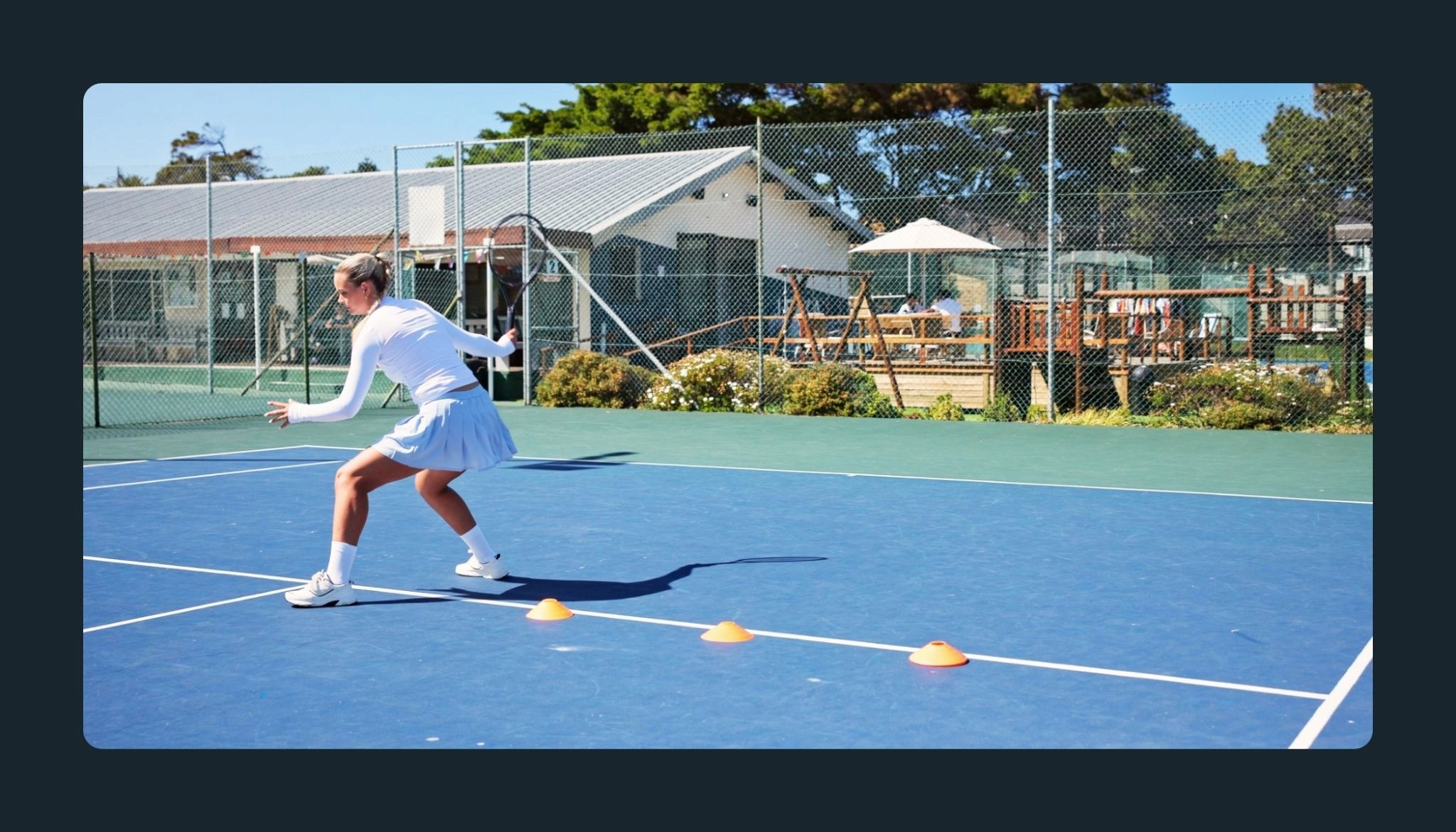
Practicing two to three times per week for 15 to 20 minutes can produce noticeable improvement within four to six weeks. Pick two or three drills per session and rotate.
Day 1: Split step + lateral shuffle + shadow swings
Day 2: Four-corner cone drill + agility ladder
Day 3: High knees + skater jumps + forward-backward shuffle
Conclusion
Balance, timing, and control matter far more than raw speed. The eight drills above cover the core movement patterns you need, and all can be practiced without a court.
Once you start playing matches, recording your sessions can reveal footwork habits that are hard to notice in real time. Spintip lets you place your phone behind the baseline, tap start, and go play without touching the device again.
SAGE, the continuously improving AI coach, delivers in-play prompts like "recover to center" and "move your feet," giving you real-time footwork cues while you play. After your session, VIEWPOINT lets you swipe through every point and see your movement on each rally.
PULSE tracks your performance number over time, so you can measure whether your footwork practice is translating to better results week after week.
Download the free Spintip app and start capturing your next session.
How long does improving tennis footwork take for beginners?
Can you practice tennis footwork drills at home without a court?
What is the most important footwork move for a tennis beginner?
Do you need equipment for tennis footwork drills?
How does footwork affect shot quality in tennis?


