Stefan Stefanov

Both pickleball and tennis are booming across the United States right now. Millions of Americans pick up a paddle or racket every year, and many wonder what the difference is between pickleball and tennis before choosing which to try. The two sports share a net, a rectangular court, and the basic goal of hitting a ball past your opponent. But the court size, equipment, rules, and physical demands are surprisingly different.
Here is a side-by-side look at both sports.
A Quick Look at Where Each Sport Started
Each sport's origin helps explain why tennis vs pickleball feel so different on the court.
Tennis

Modern tennis traces back to mid-19th century England, where Major Harry Gem and Augurio Perera developed an outdoor racket game on a croquet lawn in Birmingham. The first Lawn Tennis championship took place at Wimbledon in 1877, and the sport has been a global fixture ever since. The International Tennis Federation (ITF) now governs rules and court standards worldwide.
Pickleball
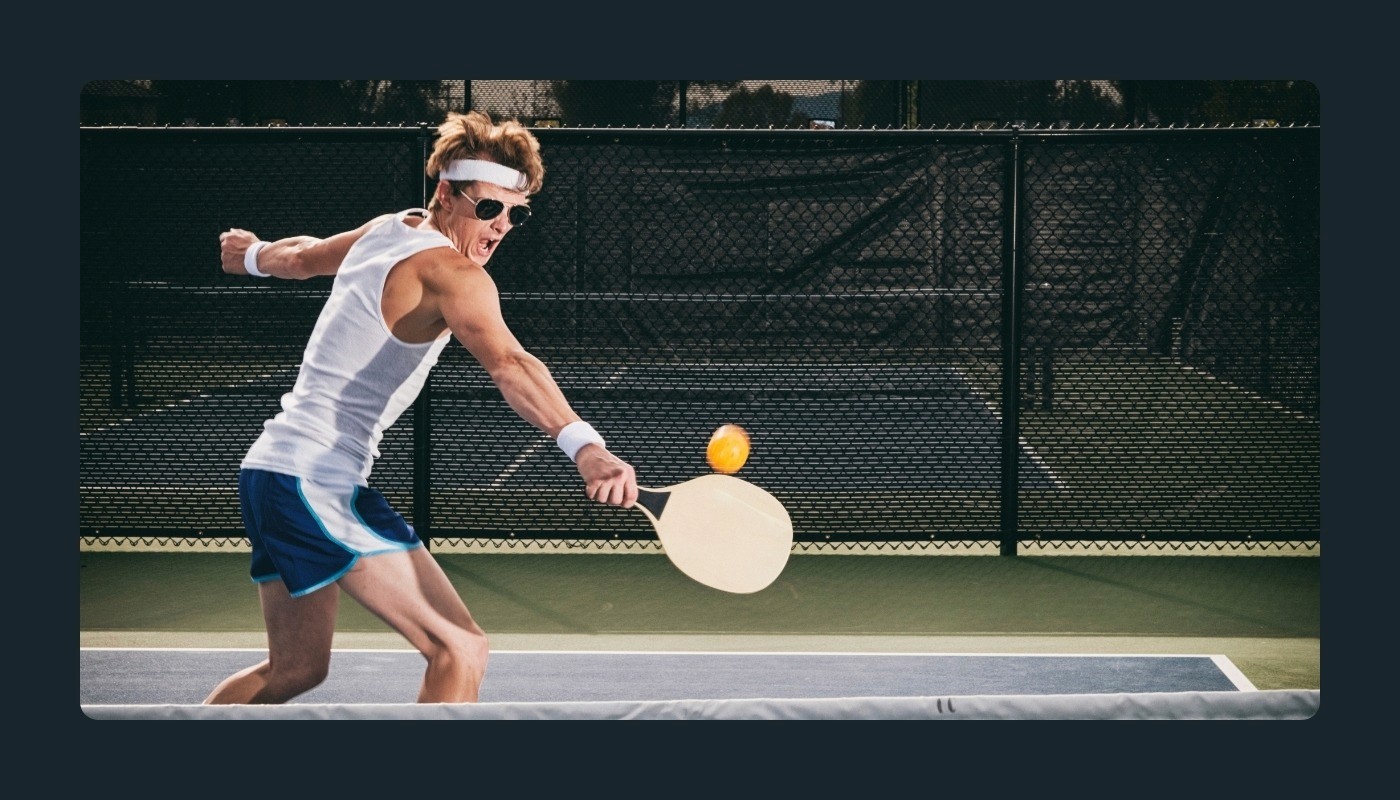
Pickleball is far younger. Joel Pritchard, Bill Bell, and Barney McCallum created the game in 1965 on Bainbridge Island, Washington. The three fathers improvised with ping pong paddles, a perforated plastic ball, and a lowered badminton net to keep their kids entertained. USA Pickleball now governs the sport's official rules in the United States.
Comparing pickleball and tennis can help you find the right fit. But whichever sport you choose, the fastest way to improve is with a certified coach who watches your real play, your actual shots and real mistakes, not textbook examples. Spintip gives you that connection for both sports. The app records your tennis or pickleball sessions, tracks your performance on every point, and lets you send any moment directly to a certified coach for feedback.
Download Spintip for free and connect with a coach for your game.
Pickleball Court vs Tennis Court
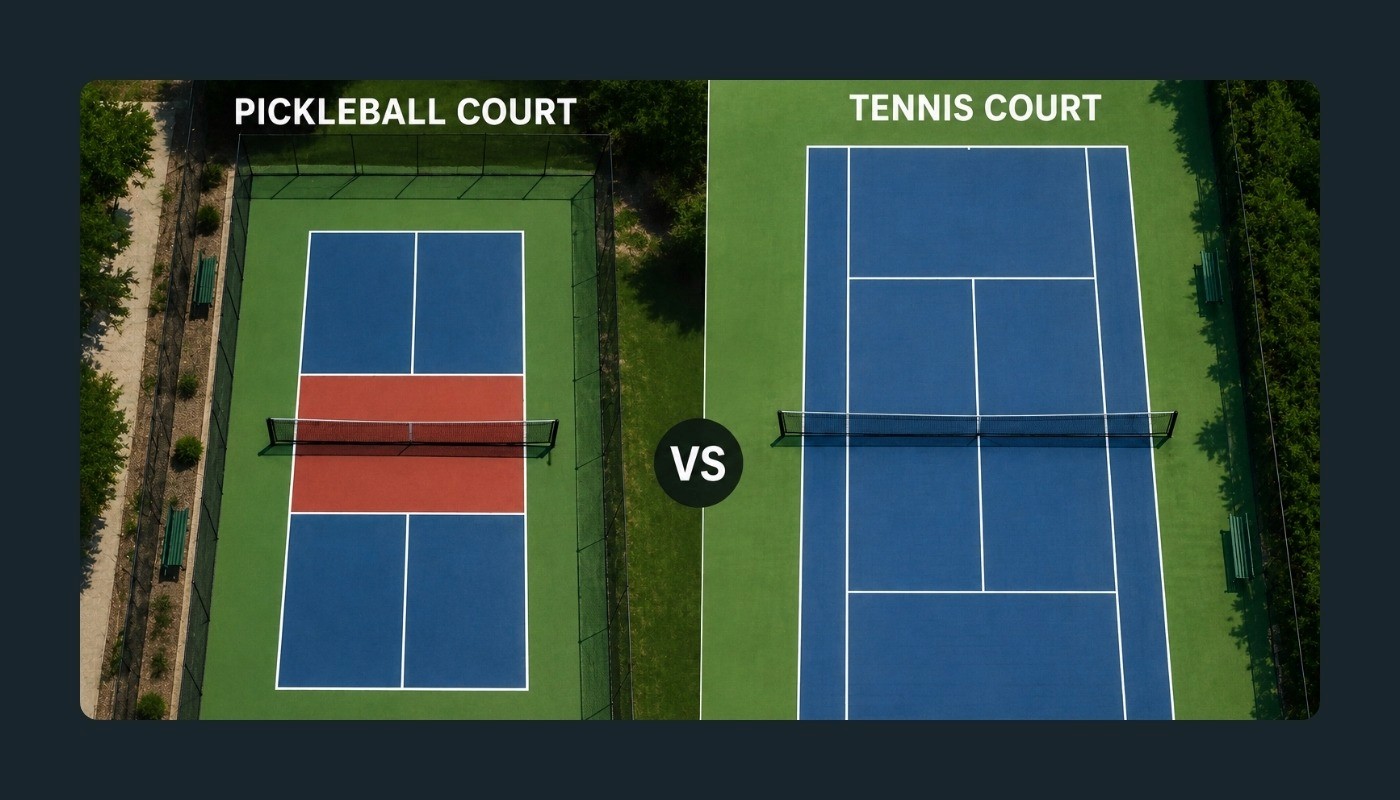
One of the most visible signs of the difference between pickleball and tennis is court size.
A regulation tennis court measures 78 feet long and 36 feet wide for doubles (27 feet wide for singles), according to ITF standards. The net stands 3 feet 6 inches tall at the posts and 3 feet at the center.
A regulation pickleball court measures 44 feet long and 20 feet wide, and those dimensions stay the same for both singles and doubles. The net sits 36 inches high at the sidelines and 34 inches at the center.
A tennis doubles court covers roughly 2,808 square feet, while a pickleball court covers about 880. You can fit four pickleball courts onto a single tennis court, which is why many facilities now convert underused tennis courts for pickleball use.
Equipment: Paddles, Rackets, and Balls
The gear for each sport looks and works very differently.
Rackets and Paddles
Tennis rackets have a frame with a bed of tightly strung strings and are typically about 27 inches long.
Pickleball paddles have a solid face with no strings. Paddles typically have a composite or polymer core with a carbon fiber or fiberglass surface. The combined length and width cannot exceed 24 inches under USA Pickleball rules.
Balls
Tennis balls are pressurized, covered in felt, and bounce high off the court surface.
Pickleball balls are hard, hollow, and made of perforated polymer plastic, similar to a wiffle ball. Outdoor balls tend to have about 40 small holes, while indoor balls often have 26 larger holes.
How the Rules Differ
Both sports use a net and involve hitting a ball back and forth, but the rules set them apart in some important ways.
Serving
Tennis allows overhand serves, and a powerful serve can often win the point outright with an ace. Players get two serve attempts per point.
Pickleball requires underhand serves. The paddle must contact the ball below the server's waist, and the serve must travel diagonally into the opposite service court. Players get one serve attempt, and there is no let rule. If the ball clips the net and still lands in the correct service court, the ball is live and play continues.
Scoring
Tennis uses a point system of 15, 30, 40, and game, with sets typically going to six games and matches played as best of three or five sets. Either the serving or receiving player can score on any point.
Pickleball games go to 11 points, and you must win by at least two. Only the serving team or player can score points. When the serving side loses a rally, the serve passes to the opponent. In doubles, both players on a team get to serve before a side-out occurs.
The Kitchen Rule
Pickleball has a unique zone called the non-volley zone, commonly known as "the kitchen." A few key facts about this area:
The kitchen extends 7 feet from the net on each side of the court.
Players cannot hit a volley (a shot taken out of the air) while standing in this zone.
You may enter the kitchen to play a ball that has already bounced, but you cannot smash a volley from there.
No equivalent rule exists in tennis, and the kitchen rule gives pickleball much of its distinct strategic character.
Physical Demands and Fitness
A tennis match can involve extensive running, quick lateral movement, and explosive sprints to reach wide shots. Matches can last from one hour to several hours at the competitive level.
Pickleball's smaller court means less distance to cover per point. Rallies tend to be shorter, and the ball generally moves slower. Many players find pickleball easier on the knees, hips, and lower back, which may make it a better fit for anyone recovering from injuries or looking for a lower-impact option.
Both sports can provide cardiovascular and coordination benefits, and either one can keep you active and improving over time.
How Easy Is Each Sport to Pick Up
Pickleball tends to have a gentler learning curve. The smaller court, lighter paddle, and underhand serve can feel less intimidating to someone new to racquet sports. Many recreational players report rallying and playing full games within their first session.
Tennis typically takes longer to develop basic skills. Coordinating an overhand serve, generating topspin on groundstrokes, and covering a full-sized court all require practice. However, tennis also offers a deeper set of shot varieties and strategic options as players advance.
A video analysis tool can help beginners in either sport spot patterns in their play and track improvement over time.
Participation and Growth in the US
Both racquet sports are at all-time highs in the United States, and neither shows signs of slowing down.
According to the USTA's 2026 participation report, 27.3 million Americans played tennis in 2025. That marks six consecutive years of growth and a 54% increase since 2019. Brian Vahaly, USTA Chairman of the Board and Interim Co-CEO, attributed the sustained growth to strong demand across diverse communities nationwide. Meanwhile, the Sports and Fitness Industry Association (SFIA) reported that 24.3 million Americans played pickleball in 2025, a 22.8% increase over 2024 and a 171.8% jump over three years. The SFIA characterized pickleball as the leading growth sport across all activities it tracks.
Pickleball remains the fastest-growing sport in America by percentage, while tennis holds a larger overall player base.
Can You Play Both
Absolutely. Hand-eye coordination, quick reflexes, court positioning, and the ability to read an opponent's shot all transfer between the two sports.
Several former professional tennis players have transitioned to competitive pickleball, which speaks to how closely the athletic foundations overlap. Playing both sports may also help prevent burnout and keep your overall game sharp.
Whether you play one sport or both, reviewing your match footage and getting feedback on your technique can speed up your progress on the court.
Conclusion
Pickleball vs tennis is not really a competition. Both sports offer fun, fitness, and a welcoming community of players. Pickleball may appeal to you if you want a lower-impact sport with a quick learning curve. Tennis may be the right fit if you enjoy a faster, more physically demanding game with deeper technique to explore. Either way, the best choice is the one that gets you on the court.
Spintip can help you improve at whichever sport you choose. Place your phone behind the baseline, tap start, and go play. The app automatically recognizes whether you are on a tennis court or a pickleball court and calibrates itself using on-device AI. When you stop, a complete game review is ready instantly, with no uploads and no cloud processing.
Swipe through every point with VIEWPOINT to spot patterns in your play.
PULSE assigns a performance number to each point, so you can track how your level changes over weeks of play.
SAGE, the continuously improving AI Coach, delivers tactical suggestions during your session and a post-game summary of specific areas to work on. When you want a professional eye on a confusing point, ANALYZE lets you record your question and send the clip directly to a certified coach for personalized feedback. After your match, one tap turns your best moments into highlight clips ready to post on social media.
Download Spintip free and start reviewing your game after every match.
Is pickleball easier than tennis?
Can I play pickleball on a tennis court?
How is pickleball scoring different from tennis scoring?
Which sport gives a better workout?
Is pickleball growing faster than tennis?


