 SPINTIP
Blog · Pickleball
Third Shot Drop in Pickleball: How to Hit It Right
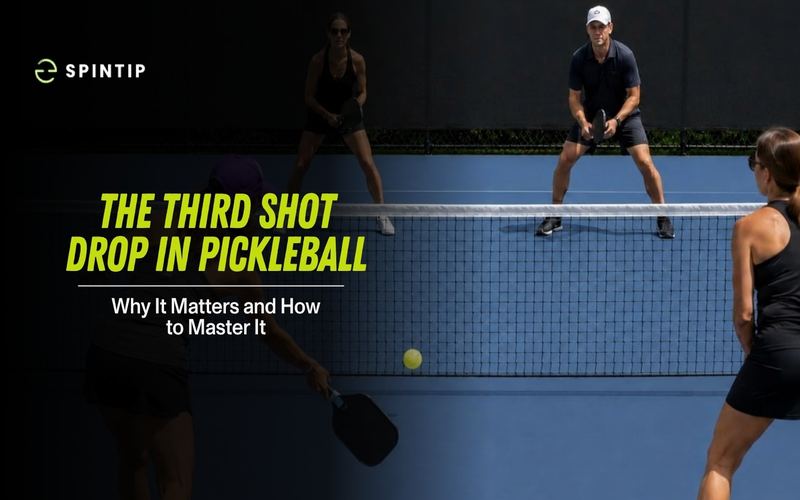
The third shot drop in pickleball is a soft, controlled shot hit by the serving team on the third contact of a rally, designed to land gently in the opponent's non-volley zone (the kitchen). The goal is to take away the returning team's advantage and give the serving team time to move forward to the net.
Most recreational players struggle with the third shot because pickleball's two-bounce rule puts the serving team at a natural disadvantage. After serving, you have to stay back and let the return bounce before you can play the ball. Meanwhile, the returning team can rush to the kitchen line. A well-placed drop is often the most reliable way to transition from defense to offense.
Here is a guide on how to execute the shot and build consistency through practice.
Why the Third Shot Matters So Much

Before getting into mechanics, you need to understand why the third shot in pickleball carries so much strategic weight.
The Serving Team Starts at a Disadvantage
Under the official USA Pickleball two-bounce rule (Rule 4.A.4 in the 2026 USA Pickleball Rulebook), the ball must bounce once on each side of the court before either team can volley. The receiving team returns the serve after the bounce and moves forward to the kitchen line. The serving team must wait for the return to bounce, which keeps them pinned near the baseline.
The kitchen line is widely considered the most dominant position on a pickleball court. Players who control that 7-foot non-volley zone tend to control the point. A hard drive can work occasionally, but the drop is typically the highest-percentage way to neutralize the opponent and move forward.
A Drop Neutralizes the Net Player
A low, soft ball that lands in the kitchen forces the opposing team to hit upward. When opponents have to hit up, they have a harder time attacking with pace or angle. The drop buys you time to advance.
Reading about the third shot drop is a great start, but nothing beats a coach who can watch your real drops and tell you whether your arc is too high, your grip is too tight, or your contact point is too late. You cannot fix what you cannot see. Spintip gives you that connection to a coach and doubles as a camera app with performance insights that track your drop consistency point by point.
Download Spintip for free and connect with a coach today.
What Makes a Good Drop Shot
A good pickleball third shot generally has three qualities that separate the shot from a regular groundstroke or a drive.
Arc Over the Net
The ball should travel in a gentle arc, clearing the net by a comfortable margin and then dropping into the kitchen. Many beginners aim too low and clip the net, or aim too high and give opponents an easy put-away.
Soft Landing in the Kitchen
The ball needs to land inside or very close to the opponent's non-volley zone, which extends 7 feet from the net on each side according to USA Pickleball court specifications.
Forward Momentum After Contact
A good drop is not just a shot, but also a trigger to move forward. After contact, your body weight and momentum should carry you toward the net.
Step-by-Step: How to Hit the Third Shot Drop

The mechanics of the third shot drop pickleball players use at every level are simpler than most people think. The shot relies on touch rather than power.
Step 1: Get Into a Semi-Open Stance
Position your feet in a semi-open stance, facing slightly toward the net rather than fully sideways. A semi-open stance keeps your swing compact and helps you direct the ball straight ahead.
Step 2: Use a Soft, Relaxed Grip
Grip pressure is one of the biggest factors in drop shot quality. On a scale of 1 to 10, aim for about a 3 or 4. A tight grip tends to send the ball too far.
Hold the paddle loosely, similar to how you would hold a dink paddle
Avoid squeezing tighter on contact, which tends to add unwanted power
Keep your wrist relatively stable and let the shoulder guide the swing
Step 3: Keep the Backswing Short
A long backswing generates too much power for a drop shot. Picture an invisible wall just behind your legs, and do not let the paddle swing past that point.
Step 4: Swing Low to High with a Lifting Motion
The swing path should move from low to high, almost like you are scooping the ball over the net. Open the paddle face slightly so the ball travels upward, clears the net, and drops into the kitchen.
Contact the ball out in front of your body, not beside or behind you
Push through the ball gently rather than slapping or poking at the ball
Follow through toward the net with your paddle pointing at your target
Step 5: Move Forward Immediately After the Shot
As soon as the ball leaves your paddle, take two or three steps toward the kitchen. Do not wait to see where the ball lands.
Take controlled, balanced steps (not a full sprint)
Read your opponent's paddle angle as you move forward
Be ready to stop and hit a reset if your drop lands too high
Common Mistakes to Avoid
Even experienced players fall into habits that weaken their drop shot execution.
Hitting Too Hard
One of the most common mistakes at every skill level. Players who swing too hard send the ball past the kitchen, giving opponents a free attack. Focus on a controlled, lifting motion instead of swinging through the ball with force.
Contacting the Ball Too Late
When the ball gets behind your body, you lose control over direction and arc. Move your feet early so you can contact the ball in front of you.
Staying at the Baseline After the Drop
A perfect drop means nothing if you remain 22 feet from the net. Every time you hit a drop, you should be taking steps toward the kitchen. Make the forward movement automatic.
Squeezing the Paddle on Contact
Under pressure, many players tighten their grip at the moment of contact. Grip tension adds power you do not want on a drop.
Drills to Build Consistency
Consistent drop shot execution comes from repetition. Here are three drills you can use during warm-ups or practice sessions.
Solo Baseline Drop Drill
Stand at the baseline with a basket of balls. Drop-feed yourself a ball, let the ball bounce, and hit a drop into the kitchen on the other side. Do sets of 20 and count how many land in the kitchen.
Partner Feed and Advance Drill
Have a partner stand at the opposite kitchen line and feed balls to you at the baseline. Hit a drop, then take two or three steps forward. Your partner returns the ball, and you reset and repeat.
Cross-Court Drop Drill
Once straight-ahead drops feel consistent, practice hitting cross-court. A cross-court drop gives you more court to work with because the diagonal distance is longer.
When to Drop and When to Drive
The pickleball third shot drop is not the right choice every time. Here is a quick comparison.
Third Shot Drop Third Shot Drive | ||
|---|---|---|
Goal | Neutralize and advance to the net | Apply pressure or force an error |
Best when | Return is deep, both opponents at kitchen line | Return is short, opponent out of position |
Touch | Soft, arcing, lands in kitchen | Hard, flat, aimed at gaps |
Risk | Too soft = net; too high = attackable | Too hard = out; telegraphed = blocked |
The best players at every level mix drops and drives to keep opponents guessing.
Conclusion
The third shot drop is one of the most valuable skills for any pickleball player. Mastering the soft touch, the forward movement, and the decision-making around when to drop versus drive can make a real difference in how you control rallies.
Reviewing your own game footage after a session is one of the most effective ways to spot patterns in your drop shot. Spintip lets you place your phone behind the baseline, tap start, and go play. Once you finish,
VIEWPOINT gives you a point-by-point game review with dead space removed, so you can swipe through every drop and see exactly where the ball landed and whether each point was a highlight or a lowlight.
PULSE assigns a performance number to each point and tracks your trend over time, so you can measure whether your drop consistency is improving session to session.
The AI Coach delivers a post-game summary of weaknesses and action items that may flag recurring drop shot errors. And if one particular drop keeps giving you trouble.
ANALYZE lets you pick that exact point, record your question, and send the clip to a coach for personalized feedback. Download Spintip free from the App Store and start reviewing your game after your next match.
Download Spintip free and get your first game review.
Rated every shot, coached on every point.
Spintip turns the phone behind the baseline into your level, your AI Coach and your coach.