Stefan Stefanov

Pickleball is one of the easiest racquet sports to pick up. The court is small, the rules are simple, and you can start having fun within your first 15 minutes.
Quick overview: Pickleball is played on a 20 x 44-foot court with a paddle and a plastic ball. Games go to 11 points (win by 2), and only the serving team can score. The serve is underhand, and the ball must bounce once on each side before anyone can volley. A 7-foot "kitchen" zone near the net prevents players from smashing at close range.
But most new players show up and get confused about serving, scoring, or that weird zone near the net. Here is everything you need to know before your first game.
What Is Pickleball?

Pickleball is a paddle sport that blends elements of tennis, badminton, and table tennis. You play on a smaller court with a lower net, using a solid paddle and a plastic ball with holes in it. A standard game is played to 11 points, and the most popular format is doubles (two players per side).
The sport was invented in 1965 on Bainbridge Island, Washington, by Joel Pritchard, Bill Bell, and Barney McCallum (USA Pickleball).
Here is what makes pickleball for beginners so appealing:
The court is about one-third the size of a tennis court.
The underhand serve is simpler than a tennis serve.
Games move quickly, usually 15 to 25 minutes.
Reading a guide like this is a great place to start. But the fastest way to go from knowing the rules to actually feeling comfortable on court is to watch yourself play. When you can see your own serves, returns, and positioning after a session, the rules stop being abstract and start making sense. Spintip is a free camera app for pickleball that records your session, removes the downtime, and lets you swipe through every point the moment you finish.
Download Spintip for free on iOS.
How Is a Pickleball Court Laid Out?
Knowing the basic layout helps everything else make sense. A regulation pickleball court measures 20 feet wide by 44 feet long, per USA Pickleball's official specifications. The dimensions are the same for singles and doubles.
Key Zones
The non-volley zone (the "kitchen"): A 7-foot area on each side of the net. You cannot volley here.
The service areas: Two boxes on each side, behind the kitchen. Serves must land in the diagonally opposite box.
The baseline: The back line of the court. You serve from behind it.
The net sits at 36 inches tall at the sidelines and 34 inches at the center.
How Does Serving Work in Pickleball?
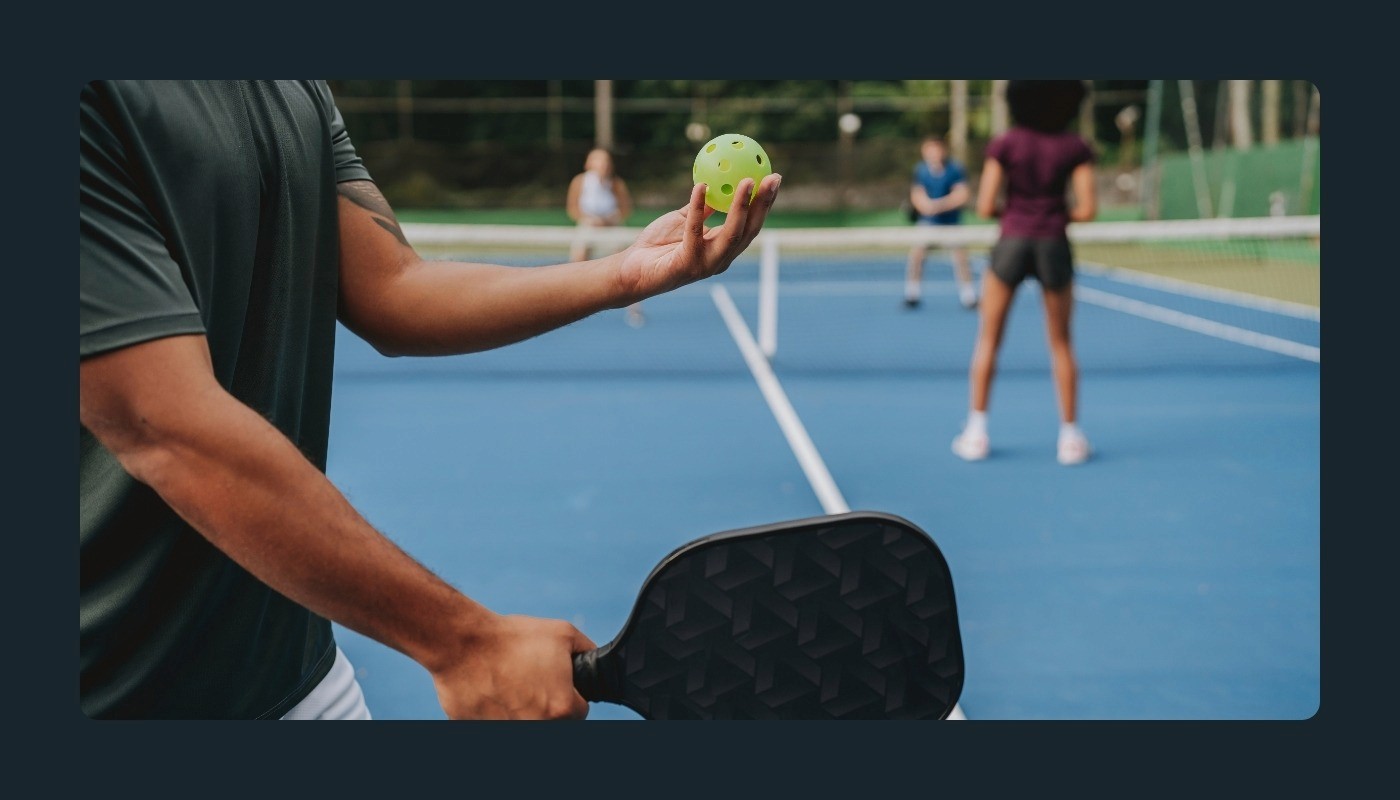
Every rally starts with a serve. Serving in pickleball is straightforward once you know the requirements.
Serving Rules
According to the 2026 USA Pickleball Official Rulebook, a legal volley serve must meet these conditions:
Your arm must move in an upward arc when you hit the ball.
The paddle head must be below your wrist at contact.
Contact with the ball must happen below your waist.
You also have the option of a "drop serve," where you drop the ball and hit it after it bounces. The drop serve has fewer restrictions, making it a good option for beginners.
Where to Stand and Aim
Stand behind the baseline. Your feet cannot touch the baseline or sideline during the serve. Aim diagonally, landing the ball in the opposite service box. The ball must clear the kitchen (including the kitchen line) to count.
What Is the Two-Bounce Rule?

One of the most important rules in pickleball is the two-bounce rule. After the serve, the ball must bounce once on the receiving side, and then once again on the serving side, before anyone can hit it out of the air.
How the Two-Bounce Rule Works
Without the two-bounce rule, the serving team could rush the net and gain an unfair advantage. Here is how it plays out:
Player A serves. Player B lets it bounce, then returns.
Player A's team must let the return bounce before hitting it back.
After both bounces, all players are free to volley.
Stay back near the baseline if you are on the serving team until that second bounce happens. Rushing forward too early is one of the most common beginner mistakes.
What Is the Kitchen (Non-Volley Zone)?

The kitchen is the 7-foot zone on each side of the net, and it has rules that trip up almost every new player.
What You Can and Cannot Do in the Kitchen
You cannot hit a volley (a shot taken out of the air) while any part of your body is in the kitchen or touching the kitchen line. Your momentum after a volley also cannot carry you into the kitchen.
However, you can enter the kitchen and hit the ball if it bounces first. So if your opponent drops a short shot into the kitchen, step in and play it off the bounce. The kitchen rule prevents players from camping at the net and smashing everything, which makes placement and soft shots just as important as power.
How Does Pickleball Scoring Work?
Pickleball scoring can feel confusing at first, especially in doubles. Once you break it down, the system makes sense.
Scoring in Doubles
In traditional scoring, only the serving team can score points. Before each serve, the server calls out three numbers:
The serving team's score
The receiving team's score
Which server is serving (1 or 2)
For example, "4-2-1" means the serving team has 4, the receiving team has 2, and the first server is up. When that server loses a rally, the second server takes over and calls "4-2-2." When the second server also loses, a "side out" occurs, and the other team gets to serve.
The 0-0-2 Exception
At the start of a game, only one player on the starting team gets to serve. The opening call is always "0-0-2." Once that server loses a rally, the serve goes directly to the other team. The reason is to reduce the advantage of serving first.
Scoring in Singles
Singles scoring uses just two numbers: the server's score, then the receiver's score. Serve from the right side when your score is even, and from the left when your score is odd.
Winning the Game
Games are played to 11 points, and you must win by 2. If the score reaches 10-10, play continues until one side leads by 2. Some tournament formats use 15 or 21.
What Are Common Faults in Pickleball?

A fault ends the rally immediately. Here are the ones that come up most often:
Hitting the ball into the net or out of bounds.
Serving into the kitchen or hitting the kitchen line on a serve.
Volleying while standing in the kitchen or on the kitchen line.
Violating the two-bounce rule by volleying too early.
Stepping on or over the baseline while serving.
If you fault while serving, the serve passes to your partner (in doubles) or your opponent (in singles). If you fault while receiving, the serving team earns a point.
How Do You Play Pickleball Doubles?
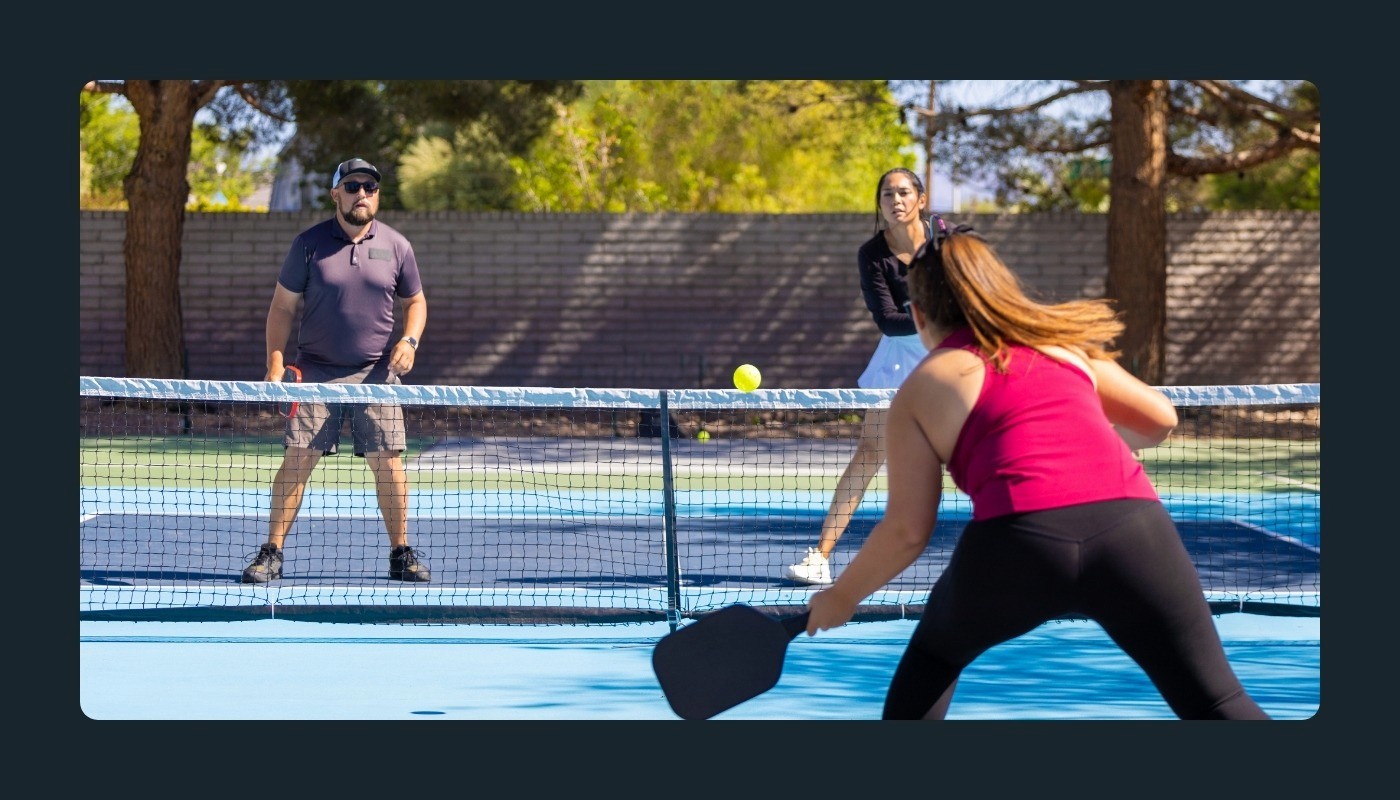
Doubles is the most popular format, and all the pickleball rules for doubles covered above apply. A few positioning details are worth knowing when you are learning pickleball for beginners in a doubles setting.
How Doubles Rotation Works
When your team is serving and wins a point, you and your partner switch sides (left and right). The same server keeps serving until your team loses a rally, then your partner takes over. After both servers lose their rallies, a side out occurs, and the other team starts serving.
Where to Stand
When your team is serving, both players should start near the baseline. When receiving, the non-receiving partner can start at the kitchen line since the two-bounce rule will not apply to them directly. After the two bounces are complete, all four players should try to move up to the kitchen line.
Tips for Your First Few Games
All you need to start is a paddle, a few pickleballs, and a court. Many parks, recreation centers, and beginner clinics provide loaner gear if you are not ready to buy your own.
Beginner-Friendly Habits
Once you have the basics down, a few habits go a long way:
Aim for the middle of the court when you are unsure about placement.
Move toward the kitchen line after the two-bounce rule is satisfied.
Use a light grip on soft shots to keep the ball low.
Call the score out loud before every serve to prevent disputes.
Conclusion
Pickleball is a game you can enjoy from day one. The court is compact, the serve is simple, and the rules reward smart play over raw athleticism. Once you understand serving, the two-bounce rule, the kitchen, and scoring, you are ready to play.
Once you start playing regularly, reviewing your matches is one of the best ways to improve faster. Spintip is a camera app built for pickleball that can help you do exactly that. Place your phone behind the baseline, tap Start, and go play. The app handles the rest.
What Spintip Offers Pickleball Players
On-device video recording and processing. No cloud uploads, no waiting. Your session is processed in real time on your phone.
Auto highlight extraction. The app trims downtime and pulls out your actual gameplay, so you skip the dead time and focus on what matters.
Point-by-point swipe review. After a session, swipe through every point individually. Swipe up to save a clip, swipe down to dismiss.
Real-time performance score. A single number that tracks how you are playing, updated point by point across sessions.
AI insights and game summaries. Get AI-generated feedback on your points and an overall summary of your match.
Coaching marketplace. Connect with certified coaches worldwide or link up with your own coach. Send curated clips with questions, and coaches respond with video or audio analysis at a pay-per-minute rate.
Social sharing. Share ready-to-post clips directly to Instagram or TikTok with zero manual editing.
Spintip is free to download on iOS. Download Spintip and get your first game review.
How long does it take to learn pickleball?
Can you play pickleball on a tennis court?
What is the kitchen in pickleball?
Do you have to win by 2 in pickleball?
What is the difference between singles and doubles scoring in pickleball?


