Stefan Stefanov

Most tennis players tend to struggle with their backhand more than any other shot. The swing happens on your non-dominant side, which feels awkward at first. And without a clear plan for grip, footwork, and swing path, it is easy to fall into bad habits that are hard to fix later.
The good news? A solid backhand does not require years of lessons or perfect athleticism. You just need a step-by-step approach that builds the right foundation. Whether you are picking up a racquet for the first time or trying to clean up your tennis backhand technique, these eight steps will walk you through exactly how to play backhand in tennis with confidence.
A backhand is any shot where you swing the racquet across your body, hitting the ball on your non-dominant side. You can hit it with one hand or two hands on the racquet.
8 Steps to Hit a Better Tennis Backhand
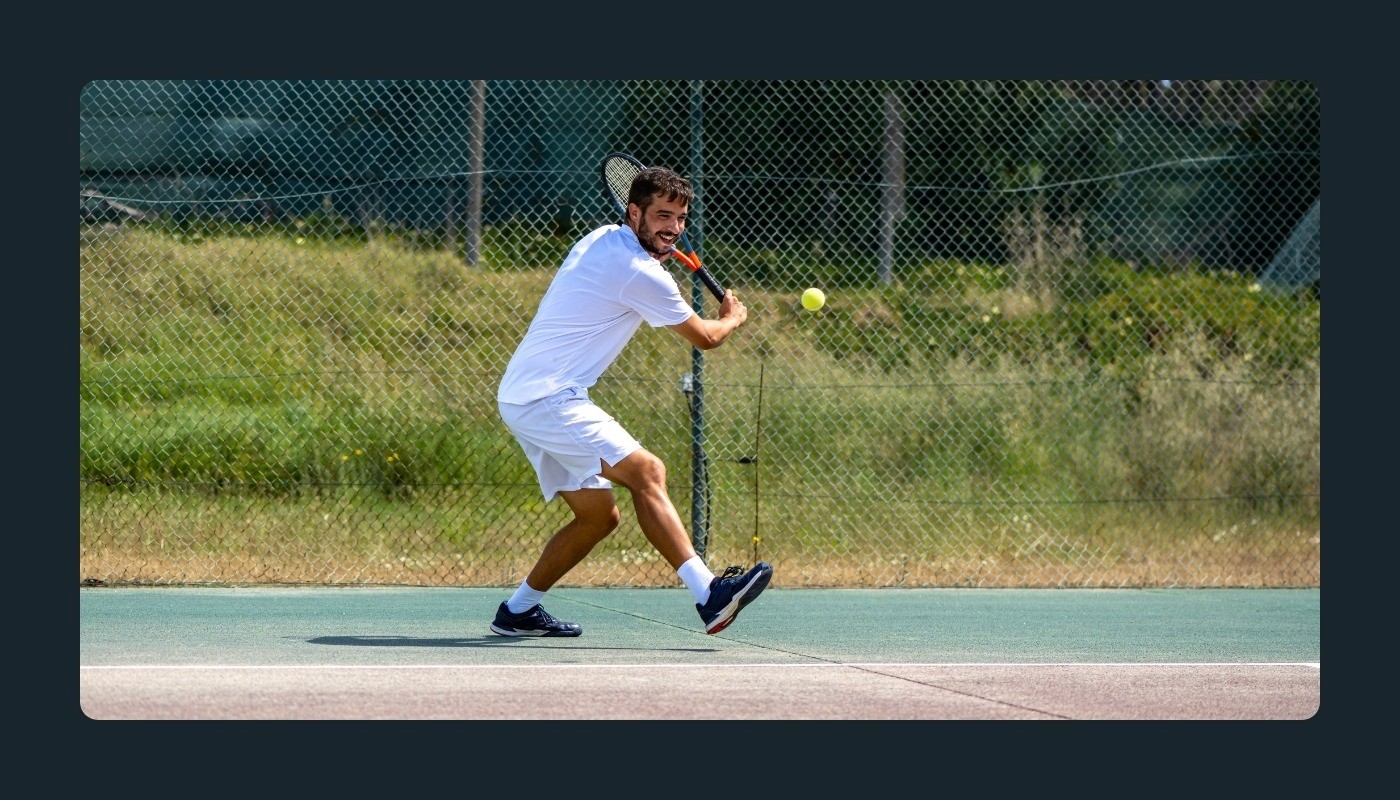
Every reliable backhand comes down to a handful of simple movements done in the right order. Once you understand how to do a backhand tennis stroke in parts, the full motion can feel much more natural.
Step 1: Decide Between One-Handed and Two-Handed
Before anything else, pick which style suits you. A two-handed backhand places both hands on the handle, with your dominant hand at the bottom. The extra hand adds stability and makes it easier to handle pace. Most recreational and professional players today use the two-handed version.
A one-handed backhand uses only your dominant hand. One-handed backhands offer more reach but generally require more upper-body strength and timing.
If you are learning how to play backhand tennis for the first time, the two-handed version is often easier. Elliott Pettit of USTA Player Development notes that the most important thing is choosing the grip that gives you the most control and comfort.
Step 2: Find the Right Grip
Your grip determines where the racquet face points at contact, which controls where the ball goes.
For a two-handed backhand:
Dominant hand (bottom): Use a continental grip. Hold the racquet as if you are holding a hammer, with the base knuckle of your index finger on the second bevel.
Non-dominant hand (top): Use an eastern forehand grip. Place the palm flat against the back of the handle so your top hand can drive through the ball.
For a one-handed backhand:
Use an eastern backhand grip. Rotate the continental grip slightly so the base knuckle of your index finger sits on the first bevel.
A common mistake is gripping the racquet too tightly. On a scale of 1 to 10, aim for about a 3. A relaxed hand allows more wrist flexibility and better racquet-head speed.
Step 3: Start in the Ready Position
Good preparation starts before the ball even crosses the net. Stand at the center of the baseline with your feet shoulder-width apart and your knees slightly bent. Hold the racquet in front of you at about waist height with both hands on the handle.
Stay light on the balls of your feet so you can push off in any direction the moment you read the incoming shot. Key checkpoints:
Face the net squarely.
Keep your elbows relaxed and slightly away from your body.
Watch the ball from the moment it leaves your opponent's racquet.
Step 4: Turn Your Shoulders Early
As soon as you see the ball coming to your backhand side, rotate your upper body so your dominant shoulder points toward the net. Your hands, arms, and racquet should all move together with your torso. The rotation of your hips and shoulders does most of the work, not your arms alone.
A good checkpoint: at the end of your turn, you should be looking at the incoming ball over your dominant shoulder. Getting this turn done early gives you more time to set up.
Step 5: Step Toward the Ball
After the shoulder turn, step diagonally toward the incoming ball with your front foot (the foot closest to the net). For right-handed players, that is the right foot. Stepping in transfers your weight from the back foot to the front foot, adding power without extra arm effort, and closes the distance so you can make contact at the ideal spot.
A comfortable stride forward is enough. Make sure your weight moves toward the ball and toward the net, not sideways or backward.
Your grip, stance, and shoulder turn all happen before you swing, and none of them are easy to feel during play. Spintip records your session and lets you swipe through every backhand point by point so you can see exactly where your preparation breaks down. Download free
Step 6: Swing Low to High
The swing path on a backhand goes from low to high. Start with the racquet below the level of the ball and swing upward through contact.
A low-to-high swing path naturally creates topspin, which helps the ball clear the net and dip down into the court. According to USTA instruction, for topspin, you brush the ball from lower to higher, like going from 6 o'clock to 12 o'clock on the racquet face.
When learning how to hit a two-handed backhand in tennis, think of the swing as your non-dominant hand driving the racquet through the ball. Some coaches describe it as hitting a forehand with your non-dominant hand. Avoid a flat, choppy swing that goes straight at the ball, as that path gives you less margin for error.
Reading blogs and watching YouTube videos can teach the basics, but nothing replaces a certified coach who can watch your backhand, identify your mistakes, and help you improve. With SpinTip, you can connect with expert coaches, analyze your strokes using video insights, and get personalized feedback based on your real performance—not just theory.
Step 7: Make Contact in Front of Your Body
You want to meet the ball slightly in front of your front hip, at about waist height. Contact too far behind you tends to send the ball long or wide. Contact too far in front can cost you power because your arms are overextended.
At the moment of contact, the racquet face should point toward your target. For a two-handed backhand, both hands stay on the racquet through contact. For a one-handed backhand, your hitting arm extends while the non-dominant hand releases behind you for balance.
Step 8: Follow Through Over Your Shoulder
After contact, let the racquet continue moving naturally up and over your shoulder.
Two-handed: Finish with both hands on the racquet, wrapped around your dominant shoulder, with your non-dominant elbow pointing roughly down the court.
One-handed: Finish with the racquet high, your chest opening up toward the net, and your hitting arm extended outward.
A smooth follow-through means you accelerate through the ball rather than slowing down at contact. After the stroke, recover to the center of the baseline and reset.
Common Backhand Mistakes to Avoid
Even with good fundamentals, a few common errors can hold your stroke back.
Gripping Too Tight
A death grip on the racquet creates tension in your arm and shoulder, which can slow your swing and reduce topspin. Keep your grip relaxed, around that 3 out of 10 level.
Late Preparation
Waiting too long to turn your shoulders means you are always rushed at contact. Start your shoulder turn the moment you recognize the ball is heading to your backhand side.
Hitting Off the Back Foot
When you make contact while your weight is still on your back foot, the shot loses power and depth. Step into the ball and transfer your weight forward through the swing.
Swinging Too Hard
More power than you might expect comes from mechanics, not raw arm speed. Proper weight transfer, a relaxed grip, and a full swing path can generate more effective power than muscling the ball. Keeping the ball on the court should always come first.
Conclusion
A reliable backhand is built one step at a time. Get the right grip, turn early, step into the ball, swing low to high, and follow through completely. Practice each piece individually, and you will likely see improvement faster than you expect.
Spintip can help you spot what you cannot feel on court. Place your phone anywhere behind the baseline, tap Start, and go play. The app's AI auto-calibrates the court and delivers a complete game review the moment you stop, with no uploads and no waiting.
VIEWPOINT lets you swipe through your backhand points one by one at variable speed, with dead space already removed, so a 90-minute session can be reviewed in minutes.
SAGE, the AI coach that continues to improve with every update, can surface real-time cues during play like "add topspin" or "recover to center," plus a post-game summary of areas to work on. If you want a human eye on a specific backhand, pick any point in your review, record your question, and send it to a certified PTR coach through ANALYZE.
Your question gets transcribed and embedded as a subtitle in the clip, and the coach responds with personalized voice or video feedback. Over time, PULSE tracks your play with a performance number for every point, so you can see whether your backhand is actually improving session to session.
Download Spintip free and get your first game review.
What is the best grip for a tennis backhand?
Should I hit a one-handed or two-handed backhand?
Where should I make contact with the ball on a backhand?
How do I add topspin to my backhand?
Why does my backhand keep going into the net?


